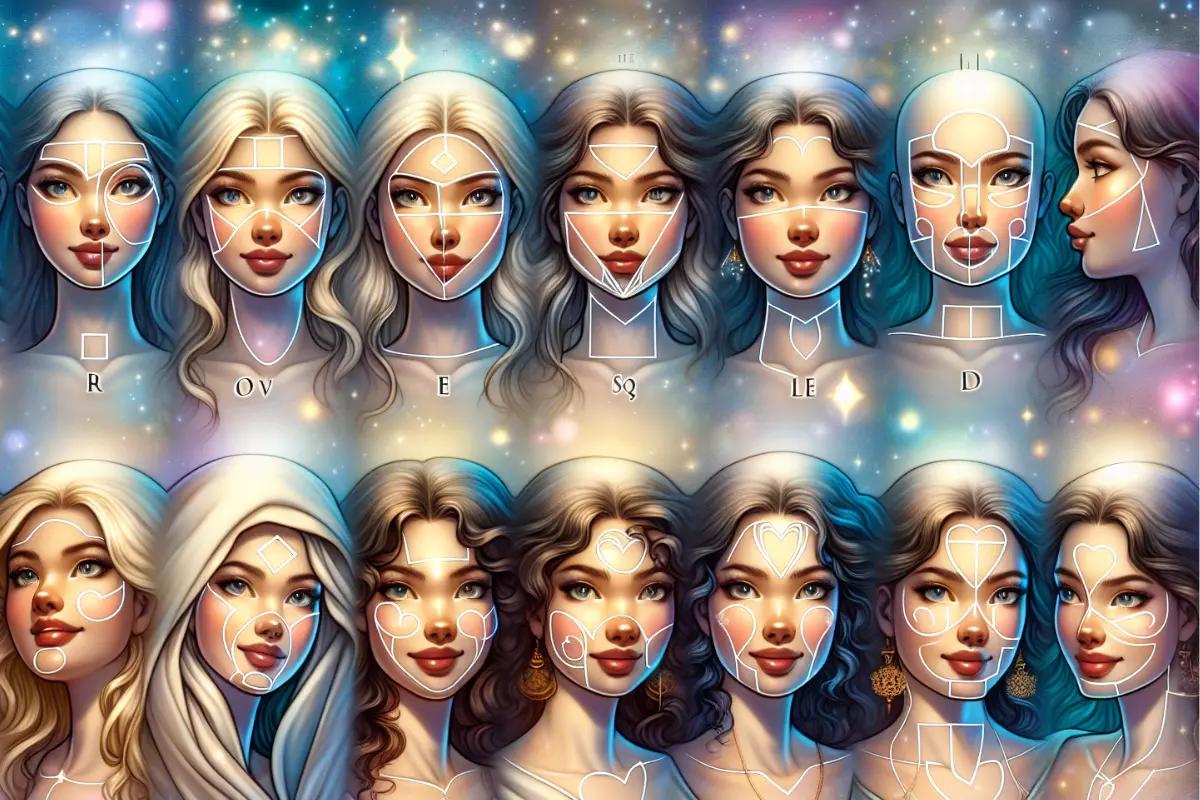
What Are the 7 Face Shapes for Women?
There are seven main face shapes. Each one has different proportions, and those proportions affect which styles look best on you.
| Face Shape | Key Features | Celebrity Example |
|---|---|---|
| Oval | Slightly longer than wide, curved jawline | Beyonce, Jessica Alba |
| Round | Equal width and length, soft angles | Selena Gomez, Kirsten Dunst |
| Square | Strong jaw, equal proportions | Angelina Jolie, Olivia Wilde |
| Heart | Wide forehead, narrow chin | Reese Witherspoon, Scarlett Johansson |
| Diamond | Narrow forehead and jaw, wide cheekbones | Rihanna, Vanessa Hudgens |
| Oblong | Longer than wide, even width throughout | Sarah Jessica Parker, Liv Tyler |
| Pear | Narrow forehead, wider jaw | Kelly Osbourne, Minnie Driver |
Most women are a mix of two shapes. Pure examples are rare. The key is finding which shape you're closest to, then using that as a starting point for makeup and styling.
Not sure which one you are? Try our face shape detector for a quick answer. You can also read our full breakdown of all 7 face shapes.
Which Face Shape Is Considered Best for Women?
The oval face shape is widely seen as the most balanced. A 2010 study in Vision Research found that faces closer to average proportions were rated as more attractive. Oval faces tend to hit that average naturally.
But "best" is misleading. Every face shape has strengths. Angelina Jolie's square jaw is one of her most striking features. Rihanna's diamond-shaped face gives her cheekbones that stand out in any photo. Reese Witherspoon's heart shape makes her look youthful and approachable.
The real advantage of the oval shape is styling ease. Most haircuts and makeup looks work without much adjustment. Other shapes just need a bit more thought about what to pick.
For a deeper look at what research says about face shape and attractiveness, read our article on which face shape is most attractive.
How Do You Figure Out Your Face Shape?
You need three measurements and a mirror.
- Measure your forehead. Place a tape measure across the widest part, from hairline to hairline.
- Measure your cheekbones. Go from the outer corner of one eye to the other, across the bridge of your nose.
- Measure your jawline. Start at the tip of your chin and measure along your jaw to below your ear. Double that number.
- Measure face length. Go from the center of your hairline straight down to the tip of your chin.
Now compare:
- Oval: Face length is about 1.5 times the width. Jaw is slightly narrower than forehead.
- Round: Width and length are close to equal. Jaw is soft and rounded.
- Square: Width and length are similar. Jaw is sharp and angular.
- Heart: Forehead is the widest measurement. Chin comes to a point.
- Diamond: Cheekbones are the widest. Forehead and jaw are both narrow.
- Oblong: Face length is clearly longer than width. Width stays even from forehead to jaw.
- Pear: Jaw is the widest measurement. Forehead is narrower.
If measuring feels like too much work, our face shape detector does it with a photo in seconds.
What Makeup Works Best for Each Face Shape?
The goal of face makeup is simple: bring things closer to balanced proportions. That means adding light where you want to draw attention and shadow where you want to slim down.
Here's what works for each shape:
| Face Shape | Contour Where | Highlight Where | Best Blush Placement |
|---|---|---|---|
| Oval | Under cheekbones lightly | Brow bone, nose bridge | Apples of cheeks |
| Round | Temples, jawline, under cheekbones | Center of forehead, chin | Angled from ear to mouth |
| Square | Corners of jaw, temples | Center of forehead, under eyes | Apples of cheeks, blended up |
| Heart | Sides of forehead, tip of chin | Center of chin, under eyes | Below cheekbones |
| Diamond | Temples, tip of chin | Center of forehead, chin | Apples of cheeks |
| Oblong | Top of forehead, under chin | Cheekbones outward | Horizontally across cheeks |
| Pear | Along jawline | Forehead, temples | High on cheekbones |
A few rules that apply to everyone:
- Blend everything. Hard contour lines look unnatural in daylight.
- Match your undertone. Cool-toned skin needs cool contour shades. Warm skin needs warm ones.
- Less is more. Start light and build up. You can always add, but removing is harder.
Makeup artist Bobbi Brown has said that the biggest mistake women make is using too much product in the wrong places. Focus on two or three spots, not your whole face.
How Should You Contour a Round Face vs. a Square Face?
These two shapes need different approaches, even though both benefit from contouring.
Round face (think Selena Gomez): The goal is to create the illusion of length and angles. Apply contour along the sides of your forehead and the outer edges of your cheeks. Sweep it under the cheekbones at a steep angle toward the mouth. This slims the face and adds structure. Skip heavy contour on the chin, as it draws attention downward.
Square face (think Angelina Jolie): The goal is to soften the jaw and temples. Apply contour at the corners of the jawline and the outer temples. Use a lighter touch under the cheekbones. A cream contour works better than powder here because it blends more naturally over angular bone structure.
For round faces, blush should go at an angle. For square faces, keep blush on the apples and blend upward. This small difference changes the overall effect.
Want more tips for these shapes? Check out our guides on round face attractiveness and square face styling.
Which Hairstyles Flatter Each Face Shape?
Your face shape matters more than your hair type when picking a cut. Here's a quick guide, with links to our detailed articles for each.
Oval: Almost anything works. Bobs, long layers, bangs, no bangs. This shape is the most flexible. See our full guide on oval face hairstyles.
Round: Go for styles that add height and length. Side parts, long layers, and volume on top all help. Avoid blunt chin-length bobs that widen the face. More ideas in our round face hairstyles guide.
Square: Soft layers and side-swept bangs balance a strong jawline. Avoid blunt, one-length cuts that emphasize the angles. Waves and curls soften the look.
Heart: Chin-length bobs and side-swept bangs work well. Volume at the jaw area balances a wider forehead. Read more in our heart face hairstyles article.
Diamond: Styles with volume at the chin or forehead balance wide cheekbones. Side-swept bangs and chin-length cuts are great picks.
Oblong: Add width, not length. Bangs shorten the face. Layers and waves at the sides help. See our rectangle face hairstyles guide.
Pear: Volume on top balances a wider jaw. Side parts, full bangs, and layered styles all work.
For a full comparison across all shapes, check our hairstyles for every face shape guide.
Does Face Symmetry Really Matter?
Yes, but less than you think.
A 2004 study published in Proceedings of the Royal Society B found that facial symmetry does predict attractiveness ratings. But the effect was small compared to other factors like skin clarity, facial expression, and overall grooming.
No one has a perfectly symmetric face. Even supermodels show slight differences between their left and right sides. What matters more is balance. A face that looks proportional and well-groomed reads as attractive regardless of exact symmetry.
Skincare, well-applied makeup, and a good haircut do more for your appearance than bone structure alone. In fact, certain facial features matter more than overall shape when it comes to how attractive others perceive you. Psychologist Dr. Viren Swami's research shows that personality traits like humor and confidence also shift how attractive others find your face.
The takeaway: work with what you have. Small styling changes based on your face shape make a bigger real-world difference than chasing perfect proportions.
What Are the Most Common Makeup Mistakes by Face Shape?
Knowing your face shape helps you avoid these common errors:
- Round faces: Applying blush in circles on the apples. This makes the face look rounder. Angle the blush instead.
- Square faces: Heavy contour along the entire jawline. This looks harsh. Focus only on the corners.
- Heart faces: Skipping chin highlight. The narrow chin needs a bit of light to balance the wide forehead.
- Oval faces: Over-contouring when you don't need to. Oval proportions are already balanced. Keep it simple.
- Oblong faces: Adding highlight down the center of the nose. This lengthens the face even more. Highlight the cheekbones outward instead.
- Diamond faces: Ignoring the forehead. A bit of highlight on the center of the forehead balances wide cheekbones.
- Pear faces: Only contouring the jaw without adding volume up top. You need both for balance.
How Can You Find Your Most Flattering Look?
Start with your face shape, then experiment. The "rules" are guidelines, not laws.
- Identify your shape. Use our face shape detector or measure at home.
- Pick one thing to try. Don't overhaul your whole look at once. Try a new blush placement or a different hair part.
- Take photos in natural light. Bathroom mirrors lie. Check your look near a window or outside.
- Give it a week. New styles feel odd at first. Wear it for a few days before deciding.
- Ask for input. A good hairstylist can tell you what works for your proportions. Bring a photo of your face shape to your next appointment.
The best look is one that makes you feel confident. Face shape guides give you a starting point, not a finish line.