A wide face has a horizontal span that matches or exceeds its vertical length. The cheeks are the widest point, and the forehead and jawline tend to be broad too. This is different from a round face, which is wide but also short with soft edges.
The goal with wide face hairstyles isn't to hide your face. It's to create visual balance by adding height and length. The right cut draws the eye up and down instead of side to side. Here's how to pick the best style for your face.
What Makes a Face Look Wide?
Face shape is measured by the width-to-height ratio (fWHR). A study in PLOS ONE found that the average fWHR is about 1.8, meaning most faces are taller than they are wide. If your face measures closer to a 1:1 ratio, you have a wider face.
Wide faces tend to share these features:
- Broad cheekbones. The widest point of your face sits at or below the cheekbones.
- Full jawline. Your jaw is close in width to your cheekbones, creating a square or rectangular outline.
- Wide forehead. The forehead spans a similar width to the cheeks.
Wide faces are common and shared by many well-known people. Chrissy Teigen, Miranda Kerr, and Ginnifer Goodwin all have wider face proportions. For men, Leonardo DiCaprio and Jack Nicholson are classic examples.
Not sure if your face is wide, round, or something else? Our face shape guide breaks down all seven types with measurements.
Which Haircuts Work Best for Wide Faces?
The best cuts for wide faces add vertical lines and height. They avoid adding volume at the sides, which makes the face look even wider.
Here are the styles that work best, organized by length:
| Haircut | Best For | Why It Works | Celebrity Example |
|---|---|---|---|
| Long layers (past shoulders) | Most wide faces | Creates vertical lines that pull the eye down | Chrissy Teigen |
| A-line lob (collarbone length) | Wide jaw specifically | Angled line narrows toward the chin | Miranda Kerr |
| Textured pixie with height | Petite frames, strong features | Height at crown shifts proportions | Ginnifer Goodwin |
| Curtain bangs with long hair | Wide forehead | Breaks up horizontal forehead line | Dakota Johnson |
| Side-parted layers | All wide face types | Asymmetry breaks the horizontal line | Jennifer Aniston |
| Shag cut (any length) | Thick or wavy hair | Layers create movement that draws the eye inward | Taylor Swift (early career) |
The common thread is vertical movement. Every cut on this list pulls attention up or down rather than across.
Do Bangs Help or Hurt a Wide Face?
Bangs can do both. The wrong bangs make a wide face look wider. The right ones narrow it.
Bangs that help wide faces:
- Side-swept bangs. They create a diagonal line across the forehead, breaking up the width. This is one of the most effective tricks for wide faces. Dakota Johnson's curtain bangs are a great example.
- Curtain bangs. Parted in the center or slightly off-center, they frame the face in a V-shape that adds length.
- Wispy bangs. Light, textured bangs that don't create a solid horizontal line across the forehead.
Bangs to avoid:
- Blunt, straight-across bangs. These create a strong horizontal line at the forehead, which makes the face look wider and shorter.
- Very short bangs. They expose the full width of the forehead.
If you have a round face that's also wide, side-swept bangs are your safest option. They work for almost every variation of a wider face shape.
How Should You Part Your Hair With a Wide Face?
Your part placement changes your face proportions more than most people realize. A center part emphasizes symmetry, which can highlight width. A deep side part creates asymmetry that breaks up the horizontal line.
Deep side part is the top choice for wide faces. It shifts volume to one side and creates a diagonal line from your part to the opposite cheek. This makes the face appear narrower and longer.
Off-center part (slightly to one side) is a good middle ground. It adds some asymmetry without the drama of a deep side part.
Center part can work if you have curtain bangs or face-framing layers that create a V-shape. Without them, a center part often draws attention to the full width of a wide face.
Chrissy Teigen almost always wears a center part but pairs it with long face-framing layers that taper inward. That's the key. If you want a center part, you need layers that narrow toward the chin.
What Hair Length Is Most Flattering for Wide Faces?
Longer hair generally works better for wide faces because it adds vertical length below the chin. But every length can work if the cut is right.
Long hair (past shoulders). This is the easiest length for wide faces. The hair hangs past the widest part of your face, drawing the eye downward. Add layers starting at the collarbone to avoid a heavy, flat look.
Medium hair (chin to shoulders). This length needs more precision. An A-line lob that's shorter in back and longer in front creates a slimming angle. Avoid blunt cuts that end exactly at the widest part of your jaw.
Short hair (above chin). Short cuts can work well, but they need height. A textured pixie with volume at the crown (like Ginnifer Goodwin's signature cut) shifts the proportions upward. Avoid cropped styles that sit flat against the head.
| Hair Length | Works If... | Avoid If... | Best Styling Trick |
|---|---|---|---|
| Long (past shoulders) | You want easy, low-effort balance | Your hair is very thin and flat | Face-framing layers starting at collarbone |
| Medium (chin to shoulders) | You want a modern, polished look | It's cut blunt at your widest point | A-line angle, shorter in back |
| Short (above chin) | You have strong features and confidence | It sits flat with no volume on top | Textured top, tapered sides |
Which Updos and Tied-Back Styles Work for Wide Faces?
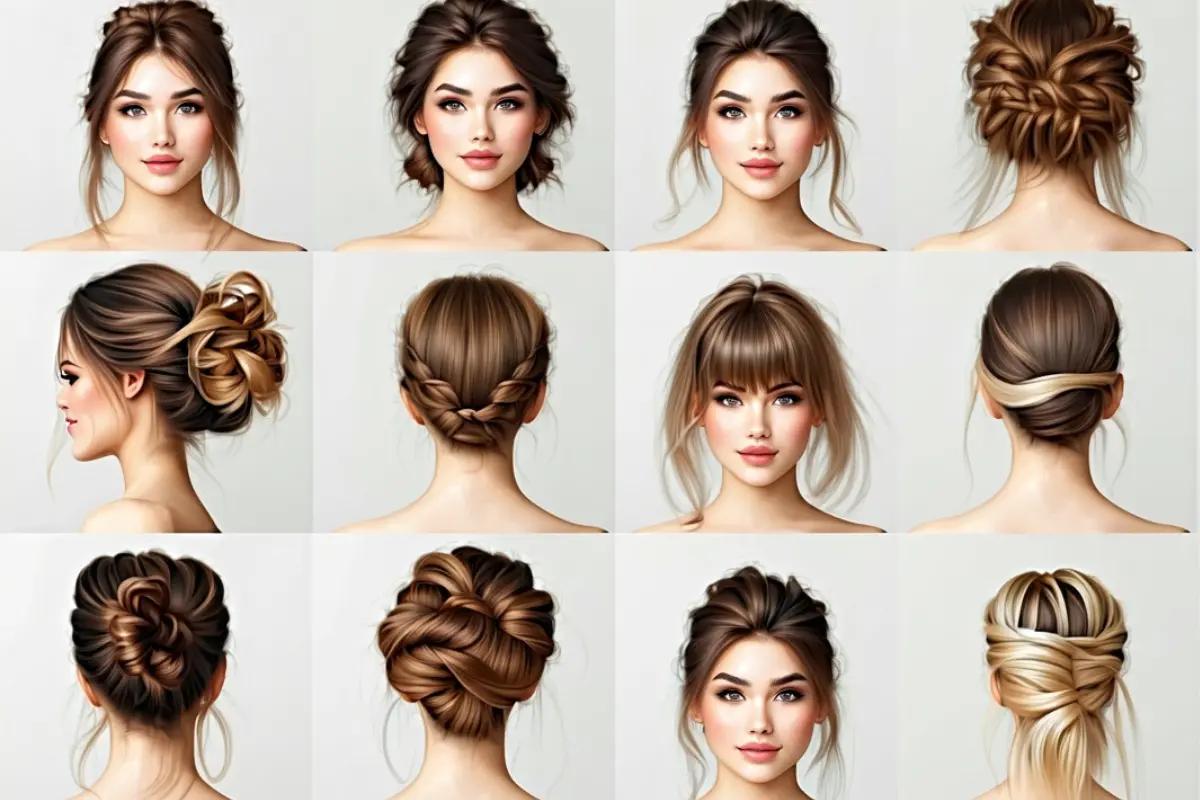
Pulling your hair back exposes your full face shape, so placement matters. The goal is to add height and keep volume at the crown, not the sides.
High bun or top knot. This is the best updo for wide faces. It adds height at the top of the head and pulls the eye upward. Leave a few face-framing pieces loose to soften the look.
High ponytail. Similar effect to a bun. Tease the crown slightly before pulling hair up for extra height.
Low ponytail with volume at crown. If you prefer a low style, add volume at the roots on top. A flat, slicked-back low ponytail can emphasize width.
Styles to skip: Tight, slicked-back buns with no volume. Side buns that add width. Low pigtails that widen the jawline.
For angular faces, the updo rules are almost opposite. Angular faces benefit from softness at the sides, while wide faces benefit from height on top.
What Styling Products Add the Right Kind of Volume?
Volume is your friend, but only in the right places. You want lift at the roots on top of your head, not puffiness at the sides.
Products that help:
- Root-lifting spray. Apply to damp roots at the crown and blow-dry upward. This creates height where you need it most.
- Dry texture spray. Adds grip and body to mid-lengths without making hair puff outward.
- Lightweight mousse. Apply to roots only. Avoid working it through the full length, which adds side volume.
- Matte pomade or wax (for short hair). Creates textured height on top of pixie cuts and short crops.
Products to use carefully:
- Heavy oils and serums. They weigh hair down, which can flatten the crown and remove the height you need.
- Salt spray. Creates great texture but can also make hair expand outward. Use sparingly and scrunch only the ends.
When styling, always blow-dry with a round brush, lifting at the roots on top. Direct the hair at the sides downward and slightly inward toward the face. This creates the vertical lines that balance a wide or round face shape.
How Is a Wide Face Different From a Round Face?
People often use "wide face" and "round face" as if they mean the same thing. They don't.
A round face is wide AND short, with soft edges, a rounded chin, and full cheeks. The width and height are nearly equal, and there are no sharp angles.
A wide face can be round, but it can also be square or rectangular. A wide square face has a broad jaw with defined angles. A wide rectangular face is both wide and long. The styling rules change depending on which type you have.
If your wide face has angular features (defined jaw, flat cheekbones), you may get better results from rectangle face hairstyles. If your wide face has soft, curved features, the round face styling guide will be more helpful.
The key difference in styling: round faces need both length and angles. Wide angular faces mainly need vertical lines and height. Knowing which type you have helps you pick the right cut.
What Should You Tell Your Stylist About Your Wide Face?
Walking into a salon with a clear plan gets you better results. Here's how to communicate what you want:
Say this:
- "I want to add height and length to my look."
- "I'd like layers that start at the collarbone and frame inward."
- "Can we try a deep side part to see how it changes my proportions?"
- "I want volume at the crown, not at the sides."
Bring references. Show photos of Chrissy Teigen's layered look, Miranda Kerr's angled lob, or Ginnifer Goodwin's textured pixie. Photos of people with similar face shapes work better than photos of models with different proportions.
Ask about face-framing layers. These are the pieces of hair closest to your face. For wide faces, you want them to angle inward toward the chin, not flare outward. A good stylist will customize these to your exact proportions.
Your face shape is just the starting point. Hair texture, thickness, and lifestyle all matter too. Use our face shape detector to confirm your shape, then bring that info to your stylist for the best results.